AI Search vs. Organic Search: What Shopify’s 2026 Data Means for Ecommerce
If you sell online, you’ve probably felt the ground shifting this year. Shoppers are asking ChatGPT, Gemini, and Perplexity what to buy, instead of scrolling through a page of blue links. The obvious worry is that AI is quietly killing search traffic to your store.
Shopify has now put real numbers to the question, and the honest answer is more interesting than the panic suggests. AI search and organic search aren’t fighting over the same slice. They’re doing two different jobs. Here’s what the 2026 data actually says, and what a store owner should do about it.
The headline: the search pie is growing, not splitting
The first thing to get straight is that this isn’t a zero-sum shift. Shopify’s own commerce data shows usage of both AI search and organic search growing at the same time. As they put it, shoppers aren’t abandoning one surface for another. The search pie is getting bigger. AI search usage is growing, but not at organic search’s expense; usage across both is growing.
That reframes the whole conversation. The question isn’t “AI or SEO.” It’s “how do I show up well in both.”
AI referrals are exploding, from a small base
The growth numbers for AI are genuinely dramatic. AI-referred sessions to Shopify storefronts grew 197% year over year in Q2 2026, and organic search traffic grew 12% over the same period. Looking back a quarter, the trend was even steeper: referral sessions from AI chatbots like ChatGPT, Perplexity, Gemini, Copilot, Claude, and Grok grew more than 8x year over year on Shopify storefronts as of Q1 2026. Search Engine Land
But “growing fast” and “big” aren’t the same thing. This is the part that gets lost in the headlines: organic search still sent more traffic to Shopify merchants than all tracked AI platforms combined. AI is the fastest-growing channel; organic is still by far the largest. Both things are true at once. Search Engine Land
The twist: AI shoppers are worth more per visit
Here’s what makes AI impossible to ignore, even at its current smaller scale. The shoppers who arrive from AI tools behave very differently, and more valuably, than organic visitors:
- More than half of AI-referred sessions start on a product page, compared to about 20% for organic search. They arrive further along in the decision. Shopify
- AI-referred sessions convert at nearly 50% higher rates than organic search. Shopify
- Average order values from AI-referred sessions are about 14% higher than organic search. Shopify
Across categories the pattern holds up strongly: AI-referred conversion beat organic in 23 of 25 merchant categories, by an average of 56% within those categories.
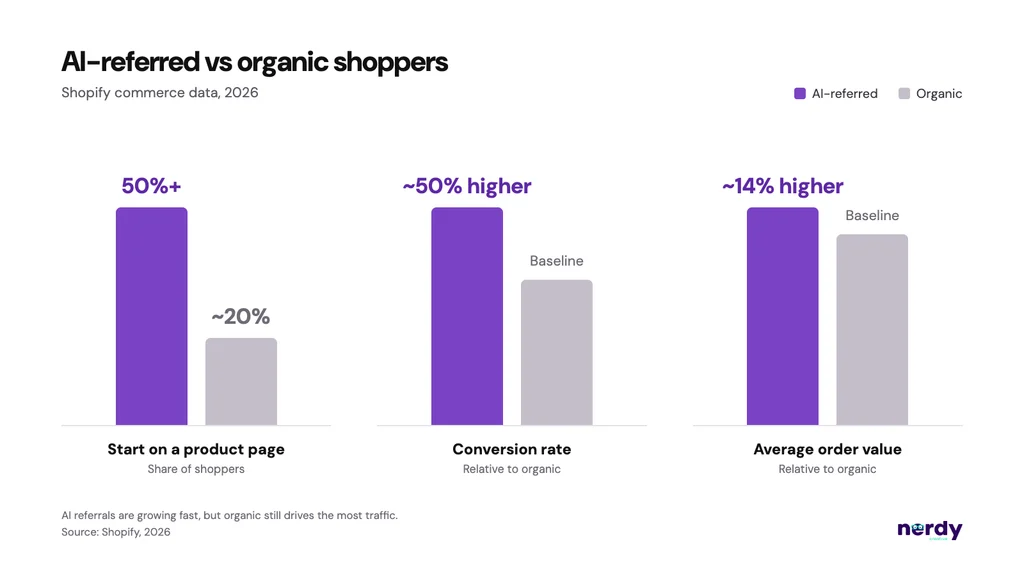
Why the gap? Because AI compresses the journey. AI search collapses the discovery and consideration phases into a single conversation, a pattern Shopify calls buyer journey compression. By the time the shopper clicks through to your store, the AI has already done the research and comparison. They’re not browsing. They’re close to buying.
Why organic search still matters more than ever
It would be a mistake to read all this as “pour everything into AI.” Organic remains the backbone of discovery. Organic search still refers more sessions to Shopify merchants than all tracked AI platforms combined, and same-store organic sessions are up over the same period.
There’s also a detail that quietly connects the two worlds: some AI-assisted discovery, like Google’s AI Overviews, sends referrals that are still counted as organic search. So the line between “AI” and “organic” is already blurrier than the labels suggest. Investing in one often strengthens the other.
The uncomfortable footnote: this can break, fast
One thing worth flagging honestly, because it affects real stores: search visibility in this new landscape can be volatile. Shopify’s July 2026 semantic search update changed how store content is indexed and ranked, and some stores reported significant drops in Google traffic. The takeaway isn’t fear, it’s that structured, well-maintained product data and technical SEO are no longer “nice to have.” They’re what keeps you visible when the rules shift. Threads
What this means for your store, practically
The strategic conclusion from the data is refreshingly clear: this isn’t a choice between SEO and AI. It’s the same underlying work, aimed at two surfaces.
- Keep investing in organic search. It’s still your largest discovery channel, and it feeds AI answers too. Don’t cut SEO to chase AI.
- Make your product data excellent. Accurate, structured, detailed product information is what both Google and AI assistants use to understand and recommend you. This is the single highest-leverage thing you can do for both channels at once.
- Optimise product pages for people who arrive ready. Since AI sends shoppers straight to product pages with high intent, those pages need to close the sale, clear specs, comparisons, answers to the obvious questions, fast load times.
- Add structured data (schema). It’s how machines read your catalogue. It helps organic rankings and makes your products more extractable by AI.
- Treat answer-engine optimisation (AEO) as part of SEO, not a separate project. The same work that improves structured product data tends to help across both surfaces.
The bottom line
AI search isn’t replacing Google. It’s adding a new, high-intent layer on top of it. Organic still brings the crowd; AI brings the shoppers who are ready to buy. The stores that win in 2026 won’t pick a side. They’ll make their product data and their pages good enough to be found, and recommended, wherever the shopper starts.
That’s the work we do every day. If you want your store built and structured to show up well in both organic and AI search, let’s talk.
Sources: Shopify Enterprise (AI search category behaviour, 2026), Shopify Enterprise (AI-referred shoppers convert better, Q1 2026), Search Engine Land, CMSWire.